Behind the Bugle
Hitting the High Notes with Churchill Downs’ Legendary Bugler, Steve Buttleman
Written by Laura Ross
It was not the most auspicious of job interviews and truly almost hit a sour note.
Steve Buttleman nearly blew his big moment—and not in the way he wanted to do it.
“I was a music student at the University of Louisville 31 years ago, studying trumpet,” he remembers. “Eight of us decided to audition for the position of chief bugler at Churchill Downs. I almost didn’t go. I was having my wife’s car worked on that morning, so I warmed up outside Midas Muffler. I arrived late, and everyone was in a coat and tie, and I was in cutoffs, tennis shoes and a windbreaker. I made it to the final two and was lucky enough to be the guy they picked.”
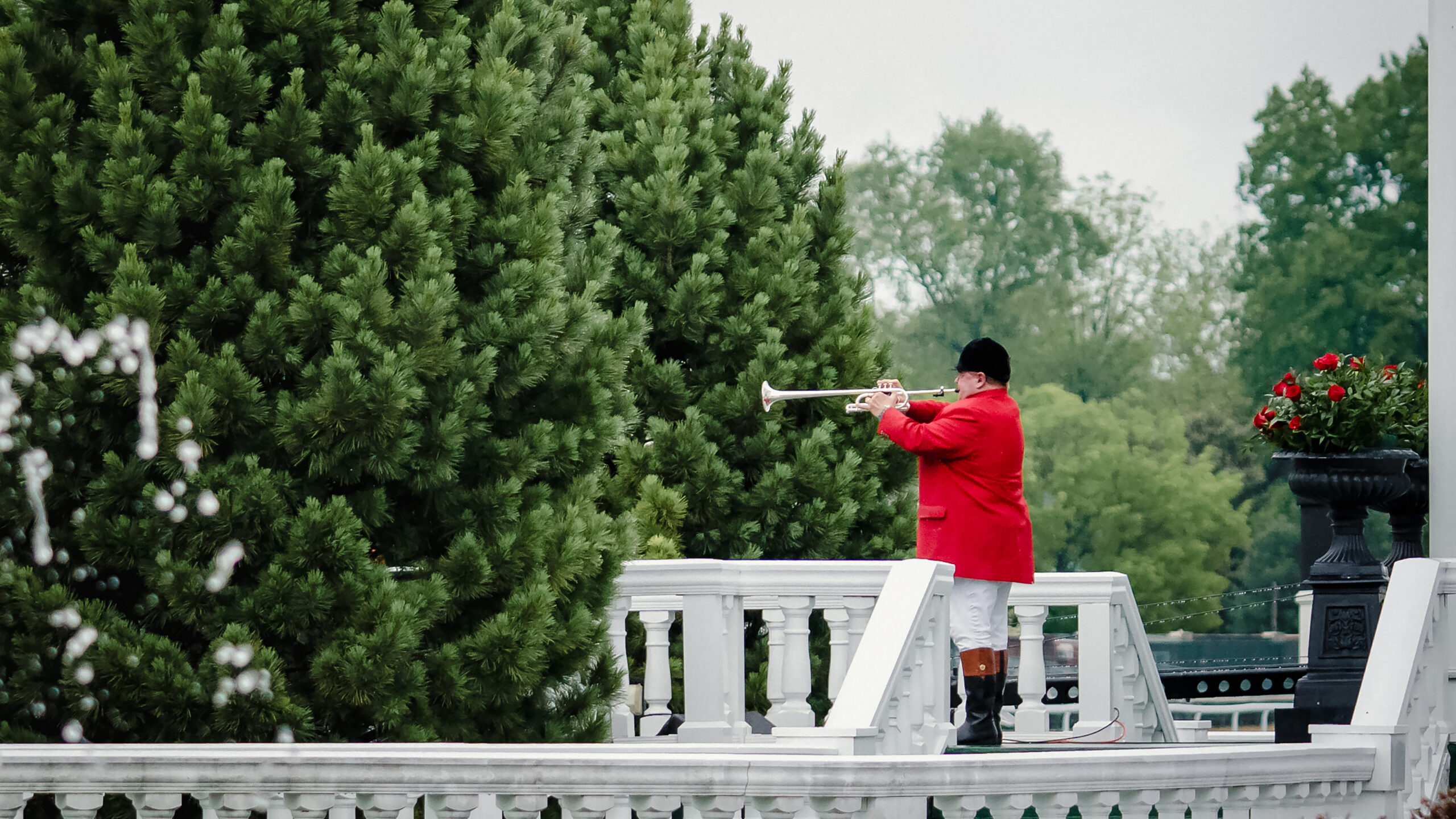
All these years later, Steve Buttleman is a well-loved and respected face at Churchill Downs and throughout Kentucky, as Churchill Downs’ famed bugler. The “Call to the Post” is one of the most iconic sounds of the Kentucky Derby that heralds the arrival of the horses onto the track shortly before a race. Buttleman has played the call thousands of times in his career and for him, every note is special.
“A reporter who didn’t understand what I do asked me once, and I answered, I’m the person at the Indy 500 who says, “Gentlemen, start your engines!” he explains with a smile. It’s so much more than that, though. It’s a full-time job that sees Buttleman as a chief bugler, an ambassador of fun and smiles, a talented musician and a local celebrity who is sought-after year-round for events and media appearances across the Commonwealth.
When he’s not working at Churchill Downs, Buttleman serves as Chief Bugler for Keeneland’s racing seasons. He appears at special events, fundraisers and even NCAA games, professional soccer matches and college and high school sporting events. He even kicked off the start of a curling tournament once with his bugle serenade. His distinctive English hunt-inspired uniform, shiny black boots and bugle are instantly recognizable everywhere he goes.
Fate nearly passed by Buttleman, who almost changed the course of his life in college. The Iowa native always had a love of music. He started playing trumpet in fifth grade and continued in orchestra in the arts program at his high school. He was a drum major in his senior year and performed in the choir. “Music just feeds my soul,” he says.
His beloved trumpet teacher in Iowa was an alum of the University of Louisville School of Music, so Buttleman set his sights on college there. He and eight friends moved to Louisville in 1983 to attend college as a trumpet performance major, with his sights on a professional music career. Once at U of L, he realized he needed to learn another skill—piano. “It took me a while because I had to learn how to play piano,” he laughs. “They call it the piano proficiency, and I was not very proficient.”
By 1986, he changed course, and steered towards studies in physical therapy and pre-med. He worked in local hospitals part-time to gain experience, and later, left U of L to attend nursing school at Spalding University. During a position working in a busy hospital ER, he met a young resident named Rhonda who was working on her ER rotation.
“We went to dinner, and seven months later, we were married,” Buttleman smiles. “We are the embodiment of the iconic quote from “When Harry Met Sally” that says, ‘I came here tonight because when you realize you want to spend the rest of your life with somebody, you want the rest of your life to start as soon as possible.’”
Their children, Megan and Tyler, arrived soon afterwards, and Buttleman stepped away from college to be with his children while they were young. In the early 1990s, he did some soul searching and decided music was his first love and where he wanted his career to head. He returned to the U of L School of Music and finished his degree.
Buttleman’s first Kentucky Derby in 1996 was an adventure. He was thrilled to be a part of the excitement but logistically, didn’t check all the boxes for the traffic quagmire that envelops Louisville on Derby Day. He didn’t have a parking pass and ended up parking in a residential yard off Central Avenue near Churchill Downs—a time honored “tradition” that sees hundreds of cars playing Jenga in people’s muddy yards in the neighborhoods surrounding the racetrack.
“I pulled out the baby stroller from the back of the car and loaded it up with my uniform and strapped in my bugle and ran several blocks to get into Churchill Downs and the infield on time,” he remembers. “The people I was working with did not think I would need credentials, because of the uniform. Security was a different story. I had to convince them that yes, this crazy guy pushing a bugle in a baby stroller WAS supposed to be there that day and actually had a pretty important job!”
While things worked out for the best, there are always challenges and crazy stories that abound during Derby Week for Buttleman. He always perseveres with a smile and cheerful outlook. His wife, Dr. Rhonda Buttleman, loves watching her husband shine. “Steve is a wonderful ambassador for Churchill Downs,” she says. “He takes his job very seriously and as a family, we get very nervous for the Derby because we know how much pressure he puts on himself. We have all been to a couple of Derby Days and it is special to see him interact with the NBC staff and see how much they respect him.”
And then, there are the children at Churchill Downs. “Steve especially loves when kids are happy to see him. So many children dress like him! He plays songs for them and gives them toy horses. People will see us out shopping or at the grocery store and will know who he is, which always amazes me.”
She laughs, “I am a pediatrician and most of my patients know he is the bugler. They will show me pictures of him they have taken at various events and ask how he’s doing. I think I’m a bit of a celebrity through him. I tease him all the time, that the only job he has had longer is being my husband!”
Like any artist, Buttleman is his own worst critic. He wants every performance to be memorable. “I want to play
perfectly every time,” he says. “I want to give fans the best experience possible. I also want to be seen as a musician—not just a bugler, but a trumpet player as well. I enjoy performing other types of music beyond bugling whenever I have the chance.” He knows his biggest fans, his parents in Iowa, are always watching on TV and will send their hearty approvals each year following his main performance.
A track “secret” to spill? It’s not always Buttleman on the bugle. “Most of the time, I play a herald trumpet because it has valves—a bugle doesn’t—which gives me more flexibility when performing “Call to the Post,” “The Star-Spangled Banner,” “My Old Kentucky Home” and other patriotic or holiday songs,” he says.
Rain or shine, he’s front and center, and all eyes are upon him. He certainly prefers a bright, temperate spring day, but sometimes, a little rain must fall. “The rain doesn’t bug me,” he admits. “The thing that bothers me the most is the wind because the trumpet’s so long and the wind usually comes out from the left, so it actually moves the trumpet, and I have to brace myself against the wind. But you know, I figure the jockeys can ride in it, so I should be able to play in it. I think it’s fun to play in those adverse conditions, because it always gives you another fun story to tell.”
His unique position means he’s enjoyed decades now of experiencing history firsthand, meeting celebrities and world leaders and being an integral part of one of the most iconic days on the calendar. Every day is a treat for Buttleman, but some encounters lodge deep in his memory. “The year Calvin Borel won The Oaks (2009) with Rachel Alexandra, I told my wife, I just know he’s going to win the Derby as well,” Buttleman says. “It was my favorite Derby. Mine that Bird went off at 50:1 and as soon as that tiny opening came on the rail, he just shot down that rail and won the Kentucky Derby. It was absolutely amazing to watch happen.”
A few years later, he met one of his idols, legendary jazz musician Wynton Marsalis. Buttleman says, “I heard he was going to play with the U of L band on “My Old Kentucky Home” so I invited him to come into the pagoda and watch the Derby with me. I didn’t have any authority to do that, but I thought, well, I’m going to take a chance. We watched the Derby together up on top of the roof.”
When he’s not bugling, Buttleman loves spending time with his now adult children, and his growing gaggle of four grandchildren and two “bonus” grandchildren of close friends. Eagle-eyed fans will often spot the children alongside their proud grandfather at many of his event performances.
He’s also a bit of a Renaissance man in his other creative endeavors. Buttleman enjoys making jewelry to relax and explore another creative outlet. He has a hobby of making and trading friendship bracelets with hundreds of people he’s met throughout his work and life. “I’ve traded bracelets from around the world,” he enthuses, “I have bracelets from Scandinavia, Africa and all over the world. It’s just fun and an easy way to make a connection with someone, and that’s what life is all about—the people who walk through it with you.”
When he crafts his custom necklaces, Buttleman often incorporates colored glass into the design. It springs from a moving memory he has from a memorial service he played for a while back. “I was playing for a service in a Catholic church at night, and I noticed they had beautiful stained-glass windows, but I couldn’t see them clearly because it was dark. It struck me that I wondered if people can’t experience God’s love unless the light comes through us like the sun through stained glass. That’s why I put a lot of glass in my necklaces; the different colors of glass are not exact, because life is beautiful, but not always one perfect color. It’s the many colors that make life beautiful.”
He adds thoughtfully, “I think it’s important to remember that, especially because as musicians, one mistake can overshadow everything else. You can forget all the notes you played perfectly and focus on the one you missed—we all do that. But we have to remind ourselves that life is beautiful, even when it’s not perfect.”
The moments leading up to the Derby may seem overwhelmingly raucous and joyous, filled with noise and revelry, but for Buttleman, they bring a deep calm as he prepares for his most anticipated performance of the day. “My office is in the pagoda in the Winner’s Circle, and when I look out my front doors and see the Twin Spires, I know it’s got to be one of the greatest office views in sports,” he says.
“An hour before Derby is when things really start to ramp up and my little house gets crowded, so I always take a walk up the turf track. When I get to the top of the stretch, I turn around and I see the Twin Spires, and hopefully, it’s a sunny day and everyone’s having a great time. I listen to the sounds of the crowd. I just think, what did I do to deserve to be this guy? “Then I say, ‘Thank you, God, and please help me not mess up.’ That helps settle my nerves so I can focus on what I need to do.”
It’s not just all in a day’s work for Steve Buttleman. It’s about a lifetime of doing what he loves best—making music and telling stories.
“I love Churchill Downs and the people behind the scenes who I feel like I stand for. I want to champion everybody who puts in all the hard work that you don’t see. The Derby has thousands of moving parts, and a lot of those people don’t wear a red coat and black boots or get to be on national TV like I do. Their contributions and interactions with our fans are of the utmost importance, and I hope I honor all of them well. I feel blessed to do my job.”
While he’s representing all those hard workers, he’s also serving the guests and visitors at the Derby. “I also feel very fortunate to use my music to connect with people,” he adds. “I love getting to share the Derby with people who are filling out their bucket lists. I know people think I’ve played the “Call to the Post” tens of thousands of times, but it could connect with the person who is hearing it for their very first time. It could be something they’ve wanted to experience their whole life. It’s a privilege to be a part of that very special moment for someone. It’s an honor I look forward to doing every day.”
“I tell my story through my music, and I love to learn other people’s stories. And, if God can use me through that, I’m a very, very lucky guy.”