A Coach’s Mind, A Trainer’s Legacy: The Life of D Wayne Lukas
How D. Wayne Lukas Reshaped Horse Racing Across Generations
Written by Kevin Kerstein
Photography by Holly M. Smith and Courtesy of Churchill Downs Racetrack

“If you’re not living on the edge, you’re taking up too much room.”
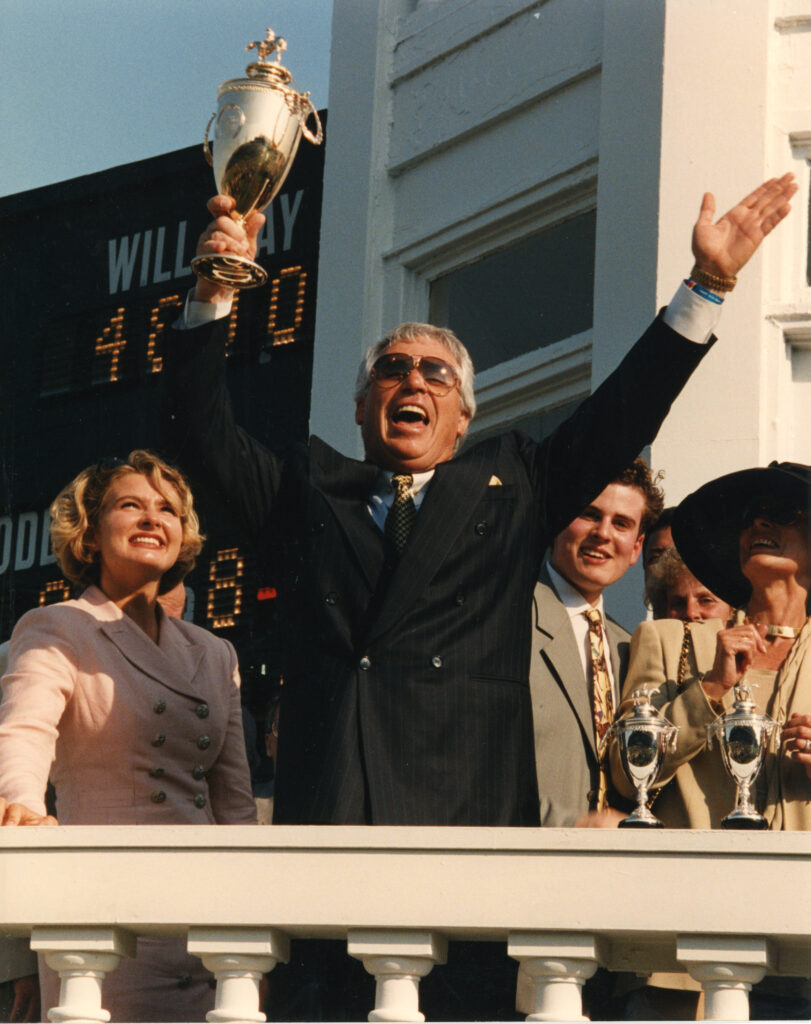
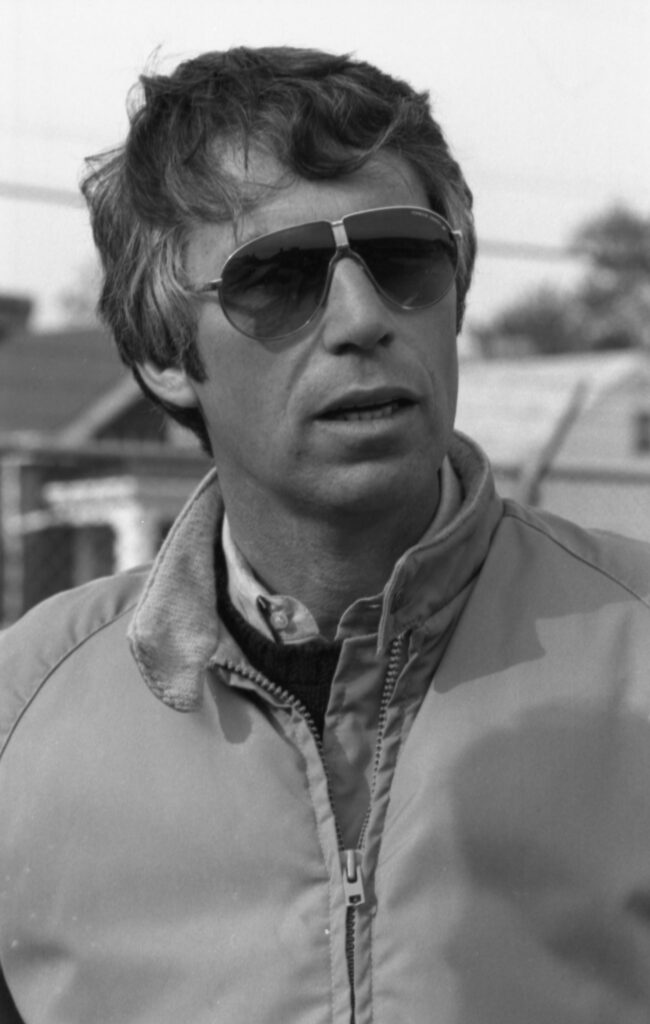
It was one of D. Wayne Lukas’ favorite lines, a motto that carried him from small-town gyms in Wisconsin to horse racing’s grandest stages. Known as “the Coach” long before he became racing’s most decorated trainer, Lukas left a modest mark in high school basketball before transforming horse racing into a new era. His legacy is defined not by box scores but by Derby roses, Triple Crown triumphs and a Hall of Fame resume that reshaped the sport.
“I’ve always just lived in the moment,” Lukas said. “When I was 16, all I wanted was to be lucky enough to run a horse where they actually bet on it. That was my dream. I had no idea what was about to happen.”
The picture that persists is simple: the white hat, the crisp button-down, the starched jeans, the immaculate cowboy boots. He ran his barn like a business and his team like a squad. There was also, always, the coach—the teacher who wanted everyone around him to get better and carried those habits to the sales ring and the racetrack.
Even though Lukas passed away at age 89 in June of 2025, his legacy shaped generations and permanently changed the entire horse racing industry.
Before the record purses and Kentucky Derby victories, Lukas worked the sidelines at Wisconsin’s Blair High School and La Crosse Logan, where he taught social studies and tested ideas that foreshadowed his racetrack innovations. He co-developed a weighted training shoe with Converse in 1961 after experiments he began while writing a University of Wisconsin thesis titled, “The Effect of Weighted Training Shoe on Jumping Performance, Agility, Running Speed and Endurance of College Basketball Players.” When the shoe went on public display at the National Sporting Goods Show in Chicago, the manufacturer reported roughly 55,000 orders. It caught on not only with his La Crosse squad but with college programs such as Ohio State, North Carolina and Kentucky.
“The boys feel they can run faster and longer and jump higher,” Lukas said. “Another big advantage is the psychological effect on players when they change into a lighter shoe.”
Even without a gaudy record, his teams had nights that mattered. On February 3, 1961, Logan upset crosstown rival La Crosse Central 59-53.
“We worked hard for this baby,” Lukas said after the game. “This is the highlight of my coaching career.”
The coaching years shaped his voice and standards. They also shaped his presentation.
“At Wisconsin, I worked in a high-end clothing store on the Capitol Square. Watching those business and political leaders walk and talk differently made me decide I wanted to carry myself, and eventually my profession, more professionally.”
In August 1967, at 31, Lukas stepped away from basketball to train horses full-time for Herbert J. Alves Racing Stables, which competed across the Midwest, moved to Denver in the fall and finished the year in California. His son, Jeff, was nine when the family made the move.
“It hasn’t been an easy decision for me because of the associations I’ve had here in La Crosse as a coach,” he told La Crosse Tribune sports editor Jim Gunderson.
Gunderson later wrote simply, “Wayne Lukas cared. He cared a lot.”
Entering the early 1970s, Lukas became one of the most visible Quarter Horse trainers in the country. In 1970, he was in the thick of the leading trainer race at Ruidoso Downs against top conditioners such as “Bubba” Cascio, “Buffalo” Wooten and Bob Arnett. That same year he conditioned Mr. Three Spot, a colt owned by Rulon Goodman who qualified for the All American Futurity, then billed as the world’s richest horse race. Mr. Three Spot finished fifth behind Rocket Wrangler, but the campaign signaled Lukas’ arrival on Quarter Horse racing’s top shelf.
The run accelerated through the mid-1970s. Lukas developed 24 Quarter Horse champions and topped national earnings in 1974, 1975 and 1976 while leading the nation in races won in 1970, 1974 and 1975. He often pointed to Dash For Cash, the 1976-77 World Champion, as the best horse he ever started. In California, he saddled Dash For Cash to the Los Alamitos Derby trials and final and the Champion of Champions in 1976, then returned in 1977 to win the Vessels Maturity, the Los Alamitos Championship and a repeat in the Champion of Champions.
“Quarter horses gave me a great foundation,” Lukas said. “You had to buy the ones that looked like athletes, because the papers didn’t mean much in those days. You learned to judge a horse on conformation and movement.”
Those years taught him to value speed, fitness and detail—and to ship to the right spot rather than wait for it to come to him. In 2007, he was inducted into the American Quarter Horse Hall of Fame, becoming the first person enshrined in both the Thoroughbred and Quarter Horse halls.
“My mother told me, ‘You can’t fool around with these horses. You have to do something worthwhile with your life,’” he remembered. “But I never stopped. Every summer I was running horses somewhere. Eventually, the horses got the best of me.”
The decision that reshaped American racing came in 1977. Lukas expanded his operation to now include Thoroughbreds on the California circuit. While Lukas tried to juggle both breeds several years prior, he gave up the first attempt because the travel between Santa Anita and Los Alamitos wore him down. This time he built the infrastructure to make it sustainable. Many horses in his stable were owned in partnerships among L. R. French, Mel Hatley, Bob Moore, Billy Walker and Bob Spreen.
In the July 29, 1977, edition of the Los Angeles Times, Lukas explained the plan.
“I will expand my staff,” he said. “The owners won’t be worried that I’m spending too much time at Santa Anita or at Los Alamitos. They’ll own horses at both places.”
At the center of the expansion was Jeff Lukas.
“My son Jeff said, ‘Dad, we can beat them across town just as easy as we’re beating them here.’ He pushed me toward the Thoroughbreds. I was reluctant, but we started with four horses at Santa Anita and got along pretty good.”
Jeff, then in his mid-20s, became the stabilizer and the enforcer—organizing day-to-day systems while Wayne recruited owners and scouted stock.
“The first meet at Santa Anita, we only had four horses,” Wayne said. “I think that your success in this game is the only thing that keeps you going. People look at successful trainers, and if you’re not very successful, people don’t look at you the same. If I hadn’t been so successful off the bat, I think things would’ve been different for us.”
As the stable grew, so did Jeff’s authority. By the 1980s he was traveling constantly, enforcing routines and standards that matched his father’s intensity. He became known as the barn’s disciplinarian, the enforcer who kept order while Wayne met clients and scouted stock.
In 1981, the Lukas stable sent out its first Kentucky Derby starter. Partez finished third in the “Run for the Roses.” Before the Derby, Wayne sent Jeff with the colt to Keeneland for his final training preparation.
In an April 21, 1981, Lexington Herald-Leader column by Gene McLean, Jeff distilled the family’s ambition: “(The Derby) is the one we really want bad. That’s what we’re hoping for. That’s the ultimate.”
The Derby success eventually came for Jeff and his father but soon after tragedy struck.
In December 1993, Tabasco Cat, a fiery colt in the stable, bolted on the track at Santa Anita and ran directly into Jeff. He was thrown violently and suffered a traumatic brain injury that left him comatose for weeks.
“When Tabasco Cat caused my son’s accident, the whole barn turned against that horse,” Wayne said. “I gathered everyone and said, ‘We’re going to make him the best horse we possibly can.’ And he came back to win the Preakness and Belmont. That was healing for all of us.”
Though he never fully recovered, Jeff fought back to a life of dignity and resilience, returning to the racetrack in a limited role. He died in March 2016 at age 58 in Atoka, Oklahoma. By then, his legend was secure—the right hand who built much of Wayne’s empire during its golden years and the son whose iron will matched his father’s. Lukas admitted later, “I probably couldn’t have done half of what we accomplished without Jeff.”
Lukas collected his first documented Thoroughbred win on October 20, 1977, at Santa Anita at age 42 and turned to Thoroughbreds on a full-time basis in 1978. He arrived at Santa Anita and trimmed his barn with white picket fencing, beds of flowers and freshly painted feed tubs used only for decoration—a trademark he used throughout his career. The presentation reinforced the message to staff and owners: order, standards and pride in the work.
Results came quickly. Acting on Lukas’ advice, Hatley purchased an interest in Effervescing in 1977. The five-year-old became one of the barn’s first national calling cards. On July 4, 1978, Effervescing won the $110,500 American Handicap (GII) on turf at Hollywood Park by three lengths, giving Lukas his first graded stakes victory. Five days later, Lukas wheeled him back in the July 10 Citation Handicap on dirt, and Effervescing won again under Laffit Pincay Jr.
“I just had a gut reaction about this horse,” Lukas said. “This horse just told me by the way he was acting this week that he was ready to run right back. When horses are going good, I believe in running them.”
Terlingua, the fast Filly who later produced Storm Cat, was among his early stars. Her dam, Crimson Saint, had been in Lukas’ care during his Ruidoso days, linking his Quarter Horse roots to his Thoroughbred rise.
His first classic-stage breakthrough came in 1980 with Codex, gifted by Hall of Famer John Nerud and Mrs. James Binger’s Tartan Farm. Codex won the Santa Anita Derby on March 30 and the Hollywood Derby on April 13, then captured the Preakness Stakes by 4 ¾ lengths over Kentucky Derby winner Genuine Risk after surviving a claim of foul for possible interference while swinging wide under Angel Cordero Jr. The running is remembered both for its controversy and the authority of the win.
That assertive style defined the next two decades. Lukas built a national training business, placing assistants at satellite strings from coast to coast. Horses shipped by air to targeted spots across North America. Trusted lieutenants ran divisions to his standards. The backstretch phrase “D. Wayne off the plane” captured the audacity and frequency of his raids on marquee races.
He became a fixture at Churchill Downs beginning in 1989, anchoring the spring with Barn 44. The opening near the six-furlong pole is commonly called the “Lukas Gap” because it sits by his longtime base.
At Churchill Downs, where he was an 11-time local champion trainer, Lukas ranks among the track’s all-time leaders: third in career stakes victories (78), fifth in career earnings ($39,198,856) and sixth in total wins (562).
In 2015, Churchill Downs renamed the former Homecoming Classic as the Lukas Classic to salute his accomplishments and influence. Since then, the 1 ⅛-mile Lukas Classic for older horses has grown from a $175,000 listed race into a prominent Grade II event with a $500,000 purse staged five weeks in advance of the Breeders’ Cup Classic.
Victories in the sport’s main arena became routine. Lady’s Secret was voted Horse of the Year in 1986, among other highlights, winning the Whitney Handicap against males. Serena’s Song took the 1995 Haskell and the Jim Beam Stakes (now known as the Jeff Ruby Steaks) while facing males seven times (she finished 16th in the 1995 Kentucky Derby). Surfside won the 2000 Clark by four lengths in her second attempt versus the boys (after finishing fifth in the 2000 Santa Anita Derby). Winning Colors, after crushing the Santa Anita Derby by 7 ½ lengths, muscled through the 1988 Kentucky Derby to become only the third Filly to win the race.
Lukas conditioned Serena’s Song (1994-96), Spain (1999-2002) and Azeri (2001-04) to become North America’s leading money-winning females—a record since eclipsed by Zenyatta—and he repeatedly tested elite Fillies against colts.
Other females he tried versus males included Life’s Magic (second in the 1983 Norfolk and 1985 Brooklyn; eighth in the 1984 Derby); Sacahuista (beaten by a nose in the 1986 Del Mar Futurity); Family Style (third in the 1986 Arkansas Derby); Cara Rafaela (fourth in the 1996 El Camino Real Derby); Sharp Cat (sixth in the 1997 Santa Anita Derby); and Azeri (eighth in the Met Mile, fifth in the 2004 Breeders’ Cup Classic).
The mid-1990s brought a mark that may never be touched. Lukas won six consecutive Triple Crown races across 1994 and 1995: the 1994 Preakness and Belmont with Tabasco Cat; the 1995 Kentucky Derby with Thunder Gulch; the 1995 Preakness with Timber Country; and the 1995 Belmont with Thunder Gulch. He added the 1996 Kentucky Derby with Grindstone, then made it seven of eight when Editor’s Note won the 1996 Belmont. Thunder Gulch was 24-1 in the Derby.
“The Preakness has always been my favorite race—not because we’ve won it seven times, but because of the way they treat you and the camaraderie,” Lukas said. “Early on, I was even guilty of using the Derby as a prep for the Preakness and Belmont.”
Charismatic pushed the story into the mainstream in 1999. Dismissed at 31-1, he rallied to win the Kentucky Derby, then backed it up in the Preakness and entered the Belmont with a Triple Crown on the line. Unfortunately, he was hurt during the stretch run of the Belmont, but thanks to the quick work of jockey Chris Antley, the injury could’ve been much worse. Voters still made Charismatic the Horse of the Year.
His Breeders’ Cup record was just as imposing. Lukas trained a record-tying 20 winners of Breeders’ Cup championship races and sent out 169 starters beginning in 1984. Three of his 20 wins came during the 1988 renewal at Churchill Downs: Is It True (Juvenile), Open Mind (Juvenile Fillies) and Gulch (Sprint), along with the 1-2-3 in the Juvenile Fillies with Open Mind, Darby Shuffle and Lea Lucinda. He was never shy about price or placement. “You can’t win it if you’re not in it,” he liked to say.
The longshot ledger reads like a tour of upsets: Take Charge Brandi at 61-1 in the 2014 Breeders’ Cup Juvenile Fillies; Spain in the 2000 Breeders’ Cup Distaff at 55-1; Cash Run in the 1999 Juvenile Fillies at 32-1; Charismatic in the 1999 Derby at 31-1; Stellar Jayne in the 2004 Mother Goose at 29-1; Codex in the 1980 Santa Anita Derby at 25-1; Thunder Gulch in the 1995 Derby at 24-1; Cat Thief in the 1999 Breeders’ Cup Classic at 19-1; Commendable in the 2000 Belmont at 18-1; and Is It True over odds-on Easy Goer in the 1988 Juvenile at 9-1.
Lukas would routinely establish records. He won 92 stakes races in 1987, a record that stood until his former assistant Todd Pletcher won 100 in 2006. He won 53 graded stakes in 1987, a mark that wasn’t eclipsed until Pletcher won 57 in 2006. In 1988, Lukas earned $17,842,358, a single-season record held until Hall of Famer Bobby Frankel’s $19,147,129 in 2003. He passed Hall of Famer Charlie Whittingham as the sport’s all-time leading money winner in 1988. He became the first trainer to amass $100 million in career earnings in 1990 and $200 million in 1999.
Across six decades, Lukas’ horses made 30,607 starts, earned more than $301 million and won 1,105 stakes, including 637 graded. He trained a record 26 Eclipse Award champions, including three Horses of the Year, earned four Eclipse Awards as outstanding trainer and was a 14-time national leader in money won (1983-92 and 1994-97). Horses under his care posted 15 victories in Triple Crown races, second only to Bob Baffert’s 17.
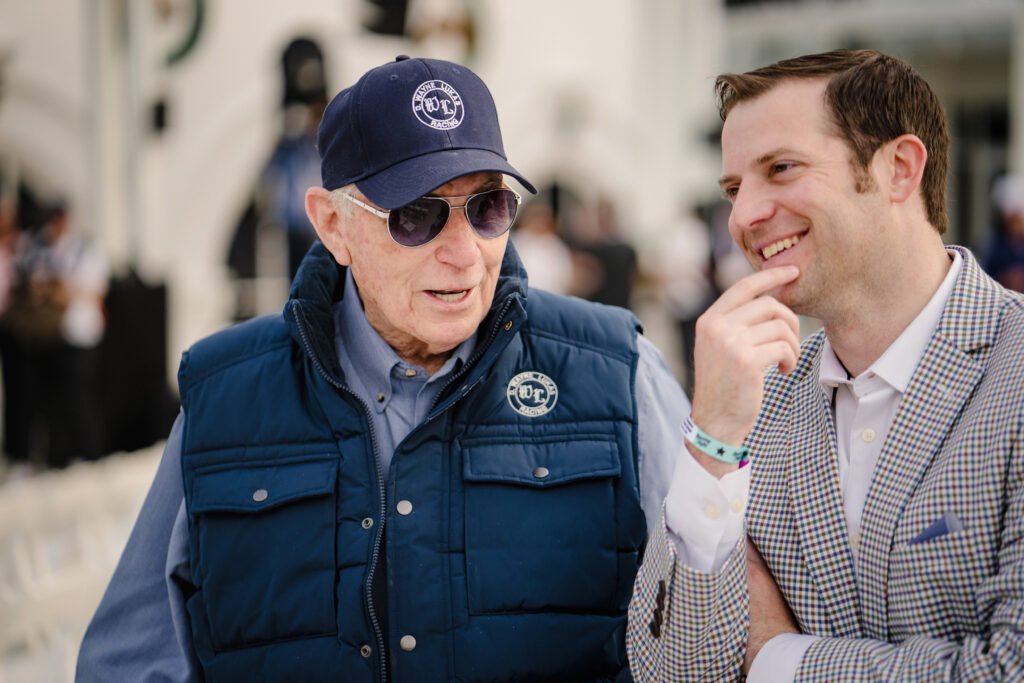


Beyond Churchill Downs, he won training titles at major tracks such as Belmont Park, Hollywood Park, Keeneland, Oak Tree, Oaklawn Park, Santa Anita, Saratoga and Turfway.
The empire produced not only trophies but horsemen. The Lukas training tree became a coaching tree, a pipeline of tremendous horseman, future stakes winners, classic winners and Hall of Famers. Former assistants include Bobby Barnett, Randy Bradshaw, Mark Hennig, Mike Maker, Kiaran McLaughlin, Todd Pletcher, Dallas Stewart, George Weaver and Sebastian “Bas” Nicholl.
“The thing I’m most proud of is the people: Todd Pletcher, Kiaran McLaughlin, Mike Maker, Dallas Stewart,” Lukas said. “Helping them grow into the horsemen they became, that’s our real legacy. The coaching background came out of me. I didn’t want ‘Yes, boss.’ I wanted them to ask, ‘Why?’ That’s how you learn.”
Pletcher has long said his years with Lukas weren’t just about mornings on the track; they were a master class in the entire business.
“Working for him wasn’t just training horses,” Pletcher says. “It was going to the Saratoga sales, looking at yearlings. He was such a good teacher and could tell you what he was looking at. To me, that was as valuable as any experience I had with him.”
Lukas’ pride in his protégé is simple.
“You go look at Todd’s stable,” he said. “He’s got so much money now, he can do it a lot better. But I’m proud that he does show that. You can drive by there, and I can proudly say that’s one of our protégés there. It reflects it. And the part of the detail—he was that way from the beginning. That’s one thing that we picked up on with any of these guys that went along with our program: they bought into the detail part. Because most young horsemen don’t think that the details amount to much. They always say, you know, I don’t think raking the shed row like a putting green is going to make the horse run faster. That’s where they miss out.”
Where did that attention to detail come from?
“I don’t know. Maybe my coaching background a little bit,” Lukas said. “I’ll tell you what did come from my coaching background is being able to depend on and to feel totally confident in an assistant. I realized right away—the philosophy that we had, and Jeff and I talked about it—was that we were sitting there looking at Charlie Whittingham, Laz Barrera, Woody Stevens, these Hall of Famers. They were training 25-30 head.
“Charlie had three or four horses he just loved, and they were stakes horses. The rest of them, I wasn’t so sure he knew their names. So we decided that, in order to keep our clientele really happy, we’d make every horse worthwhile and useful. We knew they weren’t all going to win at Belmont, Saratoga or Santa Anita, so we started looking at Monmouth Park and asking, did these 20 head fit Monmouth Park, and so forth.”
Lukas continues, “The first thing my coaching background said was: we’ve got to get top assistants who can carry it on exactly like we want. And Jeff became invaluable. Todd comes into the program, Kiaran McLaughlin was outstanding. And Dallas Stewart. You can go right down the line. Mike Maker. Every one of them became an assistant, just like a football staff. And we started making every horse pretty valuable, or at least a winner. And we had a lot of happy clients.”
At Lukas’ memorial service in mid-August 2025, Pletcher distilled it to a sentence: “A game that he permanently changed. And a sport that will never be the same.”
Hennig remembered angling for a job by timing his walk through the front gate to match Wayne’s arrival at Monmouth. Lukas noticed. A foreman’s position opened in New York.
“He literally bought me a plane ticket and shipped my car from California to New York,” Hennig said. “If he believed in you, he invested in you.”
McLaughlin framed the culture plainly: “He changed the Thoroughbred industry. He was a great coach and a great teacher to us. We all worked very well together. It’s been a great fraternity. He was almost like a second father to all of us.”
Maker also described him like a father figure: “Wayne was like a second father to all of us. He helped us grow in our lives and our career.”
Nicholl, Lukas’ most recent assistant, echoed the sentiments of several members from the training tree: “Wayne built a legacy that will never be matched. I’ll always hear his voice in the back of my mind no matter what I do.”
Lukas’ rise married horsemanship to presentation. He recruited wealthy owners and spent big with conviction. He trained for Tartan Farm; San Diego Chargers owner Eugene Klein, who bought the $575,000 Filly Winning Colors; William T. Young’s Overbrook Farm, home to Thunder Gulch and Grindstone and juvenile champion Boston Harbor; David P. Reynolds; Michael Tabor; Gainesway Stable; Bob and Beverly Lewis, who campaigned Serena’s Song and Charismatic; Brad Kelley’s Calumet Farm; and the MyRacehorse fractional group. He also trained for Mary Lou Whitney, M.C. Hammer, Mike Francesa, Bobby Knight, Pete Newell, Bill Parcells and Paul Hornung, and conditioned the first horse for the Churchill Downs Racing Club—Warrior’s Club, who posted a record of 32-5-9-5, $854,779 from 2016-19, including a win in the $250,000 Commonwealth Stakes in 2018.
On behalf of a four-man syndicate made up of himself, Klein, French and Hatley, Lukas was the underbidder on the world-record $13.1 million yearling that sold in 1985. Klein once told Sports Illustrated, “It’s said that no horse owner can give Lukas a credit card that the trainer can’t max out!”
He also knew how to make the sport bigger for fans. During the latter part of his career, he would often invite a child from the grandstand to join the Winner’s Circle after a victory and would buy the photo for the family.
“Taking little kids from the crowd into the Winner’s Circle is the most satisfying thing we do,” Lukas said. “I get letters years later from people saying they still have that picture on their wall. That’s the influence this sport can have.”
The modern chapter never felt like an epilogue. In 2013, Oxbow won the Preakness. In 2022, Secret Oath won the Kentucky Oaks. In 2024, at age 88, Lukas won another Preakness with Seize the Grey. His final triumph came June 12, 2025, at Churchill Downs with Tour Player in a seven-furlong allowance for his longtime friend and fellow Hall of Fame trainer Bob Baffert.
In the end, Lukas lived the way he spoke: “If you are going to train horses, you better have a passion for it. If you have a passion in anything in life, it eliminates all of the excuses.”
He kept showing up. He built a system that outlived any single season. He pushed the sport to scale up, to move, to believe that the right horse, in the right condition, placed in the right spot, could do more than the paper said it could.
“You can’t win it if you’re not in it.”